REVIEW · ZURICH
Self-Guided Audio City Tour in Zurich
Book on Viator →Operated by myFive · Bookable on Viator
Zurich clicks when you add stories. This self-guided audio route strings together river views, churches, Roman leftovers, and political memory, all guided by professional English narration and photo directions you can follow at your pace.
I like the easy on/off flexibility: you can pause, linger, or skip sections without feeling rushed. I also like the stop mix, from the Dada birthplace at Cabaret Voltaire to the Reformation clues around Grossmünster and the sweet opera-house facade details.
One thing to plan for: the official 2–3 hour estimate can stretch, and the audio depends on your phone’s internet. If your signal is spotty or your battery is low, playback may hiccup or restart, so bring charging confidence.
In This Review
- Key things to know before you set off
- Price and pace: $13.29 for a flexible Old Town loop
- Starting at Bahnhofplatz: Alfred Escher sets the tone
- Urania Observatory and Lindenhof: viewpoints with a backstory
- St. Peter’s Church and the “time machine” effect
- Thermengasse Roman baths: what’s underground still matters
- Rathaus and Paradeplatz: politics and money in one walk
- Grossmünster and Wasserkirche: stained glass and the Reformation lens
- Fraumünster inside vs outside: the CHF 5 decision
- Cabaret Voltaire and Lenin Apartment: Zurich’s ideas on display
- Zwingli, Waldmann, and the statue walk that teaches names
- Opera House and Ganymed: culture and myth in quick hits
- Weinplatz, guild buildings, and the Roman-to-modern throughline
- Finishing at Max Bill on Bahnhofstrasse: your endpoint is obvious
- Practical tips so the audio and directions don’t fight you
- Who should book this Zurich audio walk
- Should you book this self-guided audio tour?
- FAQ
- How long does the Zurich self-guided audio tour take?
- What does it cost?
- Is there a live guide during the tour?
- What language is the audio guide available in?
- Where does the tour start and end?
- Do I need my own phone and headset?
- Are the attractions included free to enter?
- How much does it cost to visit Fraumünster from inside?
- Is this tour private?
- Is cancellation free?
Key things to know before you set off
- You’re steering the pace. This is truly self-guided, so you’ll spend longer where you care.
- Most stops are free. Statues, churches’ exteriors, and multiple monuments cost nothing to enjoy.
- The route ends at Max Bill. You’ll finish your walk next to the Pavilion Sculpture on Bahnhofstrasse.
- Expect lots of walking. Even with stops around Old Town, you’ll want comfortable shoes.
- Internet matters for audio. A weak connection can disrupt playback.
- Fraumünster interior costs extra. Going inside the church is an optional CHF 5 ticket.
Price and pace: $13.29 for a flexible Old Town loop
At $13.29 per person, you’re paying for a professional English audio guide plus directions and photos that help you move from one landmark to the next. That’s good value in a city where “wandering” can turn into “wandering without context,” especially if you only have a few hours.
The time estimate says 2 to 3 hours, but this is one of those walks where your pace sets the schedule. If you stop for photos, read carefully, or want quieter church time, it can run longer. A few people also found the walk took closer to 3.5 hours or even around 4 hours at a leisurely speed.
Other Old Town and walking tours in Zurich
Starting at Bahnhofplatz: Alfred Escher sets the tone

Your tour begins at Bahnhofplatz, Alfred Escher-Denkmal (8001 Zürich). From the get-go, you’re not just looking at scenery—you’re getting Zurich’s “why” behind the “what.”
Stop 1: Alfred Escher Statue (free, ~5 minutes)
This monument commemorates Alfred Escher, tied to Swiss politics, the economy, and the railway system. It’s a smart first stop because it frames Zurich as a place that planned big infrastructure and business power long before modern finance took over.
Stop 2: Pestalozzianlage / Pestalozzi monument (free, ~5 minutes)
Next you get a monument to Johann Heinrich Pestalozzi, linked to enlightenment and education. It’s a nice contrast to Escher: one story about building systems for commerce, and another about building systems for learning.
Urania Observatory and Lindenhof: viewpoints with a backstory

These mid-route stops give you breathing room and a better read on the city layout.
Urania Observatory (free, ~5 minutes)
You’ll look at Zurich’s Urania Observatory, where the cosmos takes center stage. Even if you don’t go inside, the stop works as a reminder that Zurich’s curiosity isn’t only political or commercial.
Stop 3: Lindenhof Hill (free, ~10 minutes)
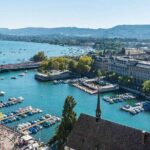
Lindenhof is the kind of place where you naturally slow down because the views are worth it. The tour ties that pause to several details: the story behind Hedwig Fountain, attention to the Masonic Lodge architecture, and a quieter moment near the Tombstone of Lucius Aelius. It’s a small sequence, but it helps you understand why this hill matters in an old river city—prominent ground, old layers, and strategic sightlines.
St. Peter’s Church and the “time machine” effect
Old Town Zurich is full of churches, but St. Peter’s gives you a practical reason to care.
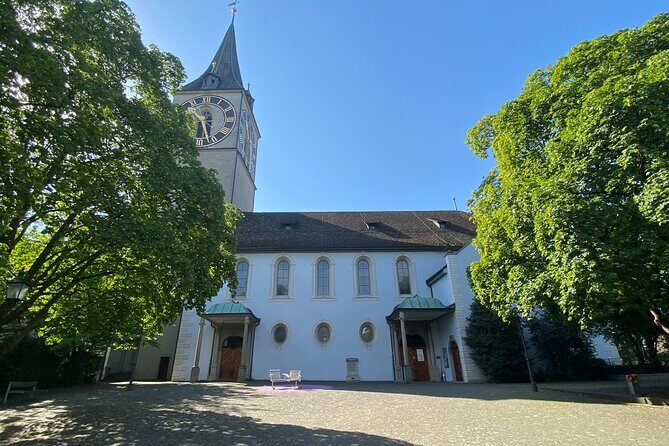
Stop 4: St. Peter’s Church (free, ~10 minutes)
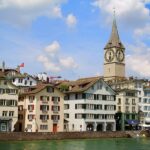
The big feature here is the iconic church clock face, one of the largest in Europe. The audio angle is helpful because it doesn’t treat the church like a photo op. You get a sense of it as Zurich’s oldest parish church and a long-running landmark—good perspective if you’re also trying to connect dates to architecture.
Thermengasse Roman baths: what’s underground still matters
Zurich isn’t only medieval. You also get a quick Roman reminder.
Stop 5: Thermengasse (free, ~5 minutes)
This stop points you to ancient Roman baths. Even if you’re not a history buff, it’s valuable because it bridges “modern Zurich” and the older settlement patterns. You’re standing in a place where layers of the city keep showing up when you look closely enough.
Other city bus and sightseeing tours in Zurich

Rathaus and Paradeplatz: politics and money in one walk
This part turns into a real-city snapshot: governance, commerce, and how the city keeps organizing itself.
Stop 6: Town Hall, Rathaus (free, ~5 minutes)
Zürich’s town hall is a political heritage marker, and the audio helps you see it as more than a building front. It’s about how power and civic decisions were represented in the public space.
Paradeplatz (free, included as a stop)
Paradeplatz is the financial-district heart. The point of this stop is contrast: after churches and Roman echoes, you suddenly see the city’s modern engine at work. Take a minute here even if you don’t care about finance—watch how fast things move, and you’ll understand why Zurich’s history leads into today so naturally.
Grossmünster and Wasserkirche: stained glass and the Reformation lens
If your brain likes connections, this is where the tour really clicks. You’re walking through Swiss Protestant storylines without needing a long textbook.
Stop 7: Grossmünster (free, ~15 minutes)
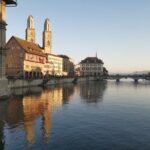
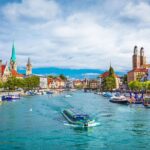
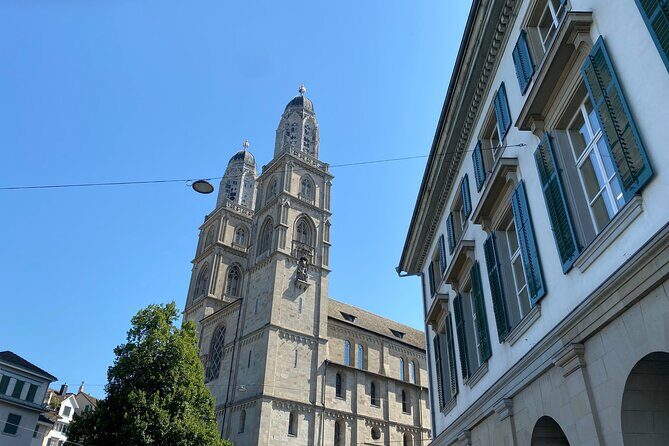
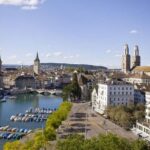
Grossmünster’s twin towers define the skyline. The audio also frames the church’s role in the Swiss Reformation. Then you get a specific artistic detail: the stained glass by Augusto Giacometti, which is described as creating a strong play of light inside. Even if you only see part of the stained glass from outside viewpoints, the audio makes you look for the “why” behind the colors.
Stop 8: Wasserkirche (free, ~5 minutes)
Wasserkirche is another stop that leans on stained glass. The practical value: it encourages you to slow down near the Limmat River and notice how many churches in Zurich use light as part of their storytelling.
Fraumünster inside vs outside: the CHF 5 decision
Fraumünster is one of those “optional effort, big payoff” moments.
Stop 9: Fraumünster Church (free outside; inside ticket not included, ~10 minutes)
The stained glass here is credited to Marc Chagall. The tour specifically notes that if you want to see the church from inside, you’ll need to pay an entrance fee of CHF 5.
My practical take: if you’re already on your feet and you want the full experience, it’s a straightforward choice. If you’re on a tight schedule or your phone battery is fading, you can still get plenty from the exterior context and keep moving.
Cabaret Voltaire and Lenin Apartment: Zurich’s ideas on display
Old Town isn’t only religion and guilds. You also get modern philosophy, art revolutions, and political exile.
Stop 10: Cabaret Voltaire (free, ~5 minutes)
This is the birthplace of the Dada movement. The audio frames it as a hub where artists and writers pushed against convention. Dada can sound abstract, but standing at the location helps—suddenly Zurich feels like a place that encouraged creative disruption, not just order.
Stop 11: Lenin Apartment Zurich (free, ~5 minutes)
Next comes Vladimir Lenin’s apartment during his exile. This stop is short, but it’s powerful because it connects the city to 20th-century political thinking. It’s also a reminder that even quiet rooms can hold loud consequences later.
Zwingli, Waldmann, and the statue walk that teaches names
This tour keeps feeding you people’s stories through monuments, not just buildings.
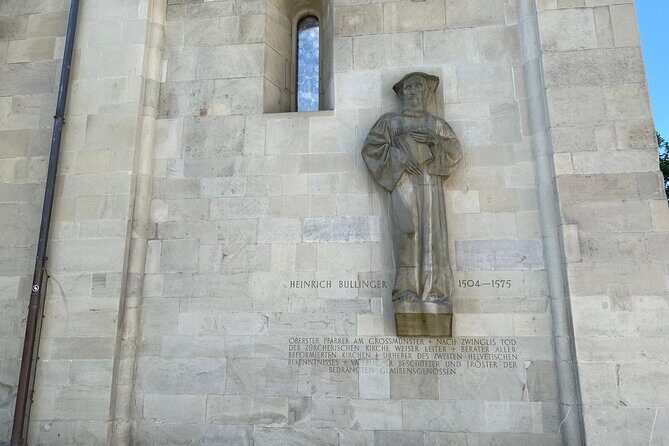
Stop 12: Ulrich Zwingli Monument (free, ~5 minutes)
Zwingli is tied to shaping the Protestant Reformation. The statue stop works well after Grossmünster because you already understand the Reformation setting; now you meet the person behind the idea.
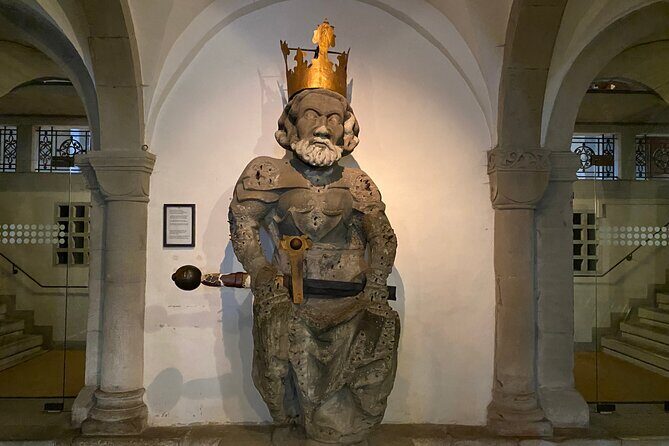
Stop 13: Hans Waldmann Statue (free, ~5 minutes)
Waldmann’s life story is given in a very human way: humble beginnings, rise to burgomaster, then a tragic end through a death sentence. It’s a strong contrast to the polished elegance you may associate with Swiss cities. If you like history that includes winners and consequences, this one lands.
Opera House and Ganymed: culture and myth in quick hits
Not every stop needs a long visit. These are quick, but they’re chosen for how well they snap together.
Stop 14: Opernhaus Zurich (free, ~5 minutes)
Zurich’s Opera House facade includes busts of composers and writers. The audio nudges you to treat it like a cultural monument, not just a place you pass by.
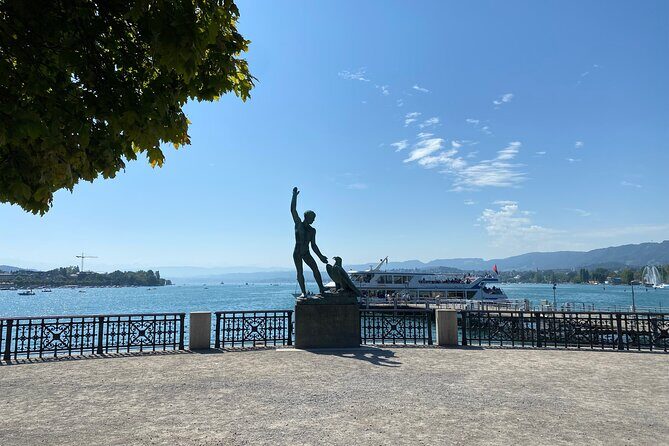
Stop 15: Ganymed (free, ~5 minutes)
You’ll see the Ganymed sculpture, tied to a mythological narrative. This stop works as a “palette cleanser” between the heavy political and religious material.
Stop 16: Augustinerkirche (free, ~5 minutes)
Augustinerkirche is described as humble, offering quiet reflection. It’s a good place to switch your brain from “reading history” to “breathing in the present.”
Stop 17: Pavillon-Skulptur von Max Bill, 1983 (#KiöR) (free, ~5 minutes)
This sculpture is all about transparency, equality, and freedom. The audio gives you a clear way to interpret the design instead of treating it like abstract street art.
Weinplatz, guild buildings, and the Roman-to-modern throughline
Stop 18: Weinplatz (free, ~5 minutes)
Here you’ll get the Millers’ and Bakers’ Guild Building context. It’s a compact stop, but it helps you see how work and city life were organized in earlier Zurich. It also ties back to the Roman and medieval stops: different eras, same question—how do people live and coordinate power?
Finishing at Max Bill on Bahnhofstrasse: your endpoint is obvious
Your tour ends at Pavillon-Skulptur von Max Bill, 1983 (#KiöR) at Bahnhofstrasse 47, 8001 Zürich. The route is designed to take you from the station area through Old Town and out toward this modern sculpture finish line.
If you’re prone to losing track, use the audio prompts as your breadcrumb trail. Some people reported confusion about where the walk ended, so don’t treat the last stop like a loose finish—watch for it.
Practical tips so the audio and directions don’t fight you
This experience works best when you set yourself up.
First, come with headphones and a charged phone. The audio relies on your mobile connection, and multiple issues tied back to internet stability or low battery. If playback resets, it’s usually a signal problem, not a “you did something wrong” problem.
Second, walking shoes matter more than you expect. The route touches a cluster of Old Town sights, and even with short stops you’ll log plenty of steps.
Third, if you need help finding a spot, the tour uses photos and directions. Those visuals are a big deal in a city with small side streets and lots of similar-looking facades.
Finally, be ready for the tour’s angle. It leans hard into early and church-centered history, and it doesn’t promise wartime topics like WWII or bomb shelters. If you want that angle, pair this with another day’s reading or a separate history-focused stop.
Who should book this Zurich audio walk
Book it if you want a self-paced way to orient yourself in Old Town without hunting for explanations. It’s especially good for first-timers who like seeing how statues and churches connect to Swiss identity.
It’s also a smart choice when your schedule is tight. For a low price, you get lots of key landmarks and a professional voice that explains what you’re looking at, step by step.
If you hate phone-dependent experiences or you know your internet is unreliable indoors and outdoors, then reconsider. And if you’re hoping for a WWII-focused tour, you might find the emphasis shifts away from that.
Should you book this self-guided audio tour?
Yes, if you want an affordable, clear way to cover Zurich’s major Old Town hits with stories attached. The format is simple: follow the instructions, stop when you care, and let the audio connect the dots between churches, monuments, and city identity.
I’d skip it only if you have low tolerance for phone glitches or you know you’ll be unhappy with a walk that may run closer to 3–4 hours instead of 2–3. Otherwise, it’s an easy way to turn “I saw the sights” into “I understood the place.”
FAQ
How long does the Zurich self-guided audio tour take?
The tour is listed as about 2 to 3 hours.
What does it cost?
The price is $13.29 per person.
Is there a live guide during the tour?
No. You explore using a link provided after booking along with the audio and directions.
What language is the audio guide available in?
The audio guide is offered in English.
Where does the tour start and end?
It starts at Bahnhofplatz – Alfred Escher-Denkmal (8001 Zürich) and ends next to the Pavillon-Skulptur von Max Bill, 1983 (#KiöR) on Bahnhofstrasse 47, 8001 Zürich.
Do I need my own phone and headset?
Yes. You need your own mobile phone with internet and a headset.
Are the attractions included free to enter?
Most stops are admission free, but Fraumünster interior is an exception.
How much does it cost to visit Fraumünster from inside?
If you want to see Fraumünster from inside, the tour notes an entrance fee of CHF 5 per person (ticket not included).
Is this tour private?
Yes. It’s described as a private tour/activity, with only your group participating.
Is cancellation free?
Yes. Free cancellation is allowed up to 24 hours in advance for a full refund.