REVIEW · ZURICH
Einstein in Zurich: Walk in Time Exploration Game and Tour
Book on Viator →Operated by Questo · Bookable on Viator
Einstein in Zurich turns city streets into a game. I like how it mixes Zurich landmarks with Einstein-flavored science in a way that feels playful, not preachy. You get 11 interactive puzzle challenges that guide you from clue to clue as you wander at your own pace, which also helps you avoid the usual crush of guided tours.
I also like the flexibility: you can pause and resume anytime, and you do not need to match a strict group schedule. One thing to consider: because it runs through a mobile app with directions and puzzles, a weak internet moment or an app hiccup near the end can throw off your flow, and the walking can feel like more than a quick stroll.
If you want a straightforward Einstein bio trivia tour with a person explaining everything, this may not be your best match. If you want a fun, family-friendly way to cover real places like Münsterbrücke and Paradeplatz, it’s much more promising.
In This Review
- Key things I’d watch for (before you buy)
- Turning Zurich into an interactive time walk
- Price and what $7.21 actually buys you
- Start at Rathausbrücke and end at Polyterrasse
- What the 11 puzzle challenges feel like in real life
- The Einstein angle: science as story, not a textbook
- Landmark time: where Münsterbrücke and Paradeplatz fit in
- Walking pace and directions: what can go right or wrong
- Best for families, and also for curious walkers
- Timing: how to fit 1 hour 40 minutes into a Zurich day
- Getting around: near public transportation, but it is still a walking route
- English support and private-group feel
- What it’s like at the end of the game
- Should you book this Einstein in Zurich walk?
- FAQ
- How long does Einstein in Zurich: Walk in Time Exploration Game and Tour take?
- How much does it cost and what’s included?
- Do I need a physical tour guide?
- Where does the tour start and end?
- Is the tour available in English and is it private?
- What’s the cancellation rule?
Key things I’d watch for (before you buy)

- You’re self-led, so clear phone instructions matter. Plan for navigation on foot.
- Puzzles run the show: 11 interactive challenges keep you moving and thinking.
- Family-friendly pace: tasks make it easier to hold kids’ attention.
- Not a deep Einstein lecture: science is woven into the story, not heavy relativity problem-solving.
- Tech can be a weak link: one report mentioned the app crashing right at the end.
Turning Zurich into an interactive time walk

This is a walk-through-Zurich experience that leans on story and problem-solving. Instead of checking off stops with a guide’s patter, you follow clues on your phone and solve puzzle tasks along the way. The idea is simple: your brain stays busy while your feet handle the city.
The theme is Einstein, but the tour is more about using Einstein’s ideas as a storytelling engine than turning Zurich into a museum of his life. You’ll get Zurich history mixed into the narrative, and the puzzles are tied to that storyline. For many families, that’s the sweet spot: kids get something to do, and adults still learn what they’re looking at.
The route is also designed for flexibility. Even though the experience is about 1 hour 40 minutes on average, you can pause and resume. That matters if someone needs a bathroom stop, or if you want to linger for photos without feeling guilty.
Other walking tours we've reviewed in Zurich



Price and what $7.21 actually buys you

At $7.21 per person, this falls into the category of a low-cost activity that can replace a more expensive guided option. You’re not paying for a guide’s time. You’re paying for the structure: the mobile access code, the app-based storyline, and the set of 11 puzzle challenges.
That value angle is key. If you enjoy walking and you like interactive apps, you can stretch the experience because you control the pace. If you prefer face-to-face explanations, you might feel like you’re doing the work without the payoff. And since the tour is self-led, you also shoulder the navigation and timing.
So the question isn’t just cost. It’s: do you want a game-like city walk, or do you want a human guide telling you what matters most?
Start at Rathausbrücke and end at Polyterrasse
Your game begins at Rathausbrücke, 8001 Zürich. That’s a practical choice because it puts you in the old-city core area where walking connections are easy. Instead of meeting at a museum door and then commuting across town, you start in a place that’s already surrounded by landmark energy.
You’ll finish at Sport Center Polyterrasse, Zurich Academic Sports Association, Leonhardstrasse 36, 8006 Zürich. Ending at a sports-center terrace sounds unusual, but it’s useful. It’s a clear endpoint you can orient to, and it also keeps the walk from feeling like a closed loop where you’re stuck retracing steps for no reason.
The official process is straightforward: you follow the instructions inside the Questo mobile app. You get a mobile access code as part of the experience. In practice, that means your phone isn’t optional. Bring a charged device and be ready to use the app as your guide.
What the 11 puzzle challenges feel like in real life

The tour is built around 11 interactive puzzle challenges. Each segment works like this: you reach a spot, get a clue, solve a puzzle, then receive directions for what’s next. While you’re doing that, the storyline content gives you context about the place you’re standing in.
That’s why this can work so well for families. Kids get constant “what’s next” pressure in a good way. Adults get a reason to pay attention rather than drifting through famous streets like a casual tourist.
Still, puzzles can be a mixed bag. One clear downside from real feedback is uneven difficulty. Some people found clues hard enough that hints were necessary. That’s not automatically bad—hints can keep the experience from turning frustrating—but it does mean you should be okay with a little trial and error.
One more practical note: since you move through multiple steps, you’ll want to watch battery life. If your phone dies, you lose the map-and-clue layer that drives the whole walk.
The Einstein angle: science as story, not a textbook

This experience is described as having a storyline inspired by Einstein’s theories and Zurich history. Translation: you’ll learn in small pieces, woven into the game, not through long lectures.
If you’re hoping for a tour that gives you detailed Einstein biography facts with a strong emphasis on specific relativity mechanics, you may find it too light. One person even pointed out that engineers looking for precisely defined relativity-style problems were likely to be frustrated. That’s a useful warning.
But if you want an accessible, story-driven introduction that nudges you to connect what you see in Zurich with the Einstein theme, you’ll probably enjoy it more. This is a city walk with science flavor, not a graduate seminar.
A few more Zurich tours and experiences worth a look






Landmark time: where Münsterbrücke and Paradeplatz fit in
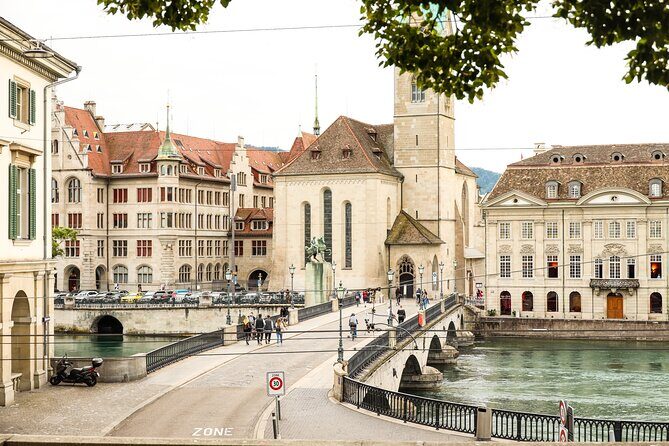
You’ll explore well-known central Zurich landmarks, including Münsterbrücke and Paradeplatz, plus additional stops along the way. The best part of including places like these is that they anchor your game in real geography.
- Münsterbrücke is the kind of landmark that instantly gives you a Zurich feel. You’ll be able to look around and recognize why this area matters as you solve the next clue.
- Paradeplatz brings you into the city’s more iconic commercial heart. Even if you’ve walked past it before, the game structure can make you notice details you’d normally ignore.
The practical benefit is that your walking route is not random. It’s built around places that are easy to recognize and easy to photograph, which makes the experience feel like more than just following phone prompts.
Walking pace and directions: what can go right or wrong
The experience is built for walking. That’s obvious, but it still deserves respect. One major complaint was that the directions weren’t always clear, and the walking felt heavy for the level of guidance provided.
Here’s how to plan to avoid that: before you start, take a moment to confirm your phone is connected, your location services are on (if the app uses them), and you understand what “next” means on-screen. Also, if you’re walking with kids, agree on a simple rule: stop and check the app before you commit to a wrong turn.
Tech reliability is another real-world factor. One report mentioned the app crashing right at the end, so the final steps didn’t complete. That doesn’t mean it will happen to you. It does mean you should treat the last segment carefully: keep your phone charged and expect that the ending might require a bit of patience if something goes wrong.
There was also a report of start-up trouble, where a hotline wasn’t reachable and a chatbot didn’t respond, with the added frustration of paying twice. That’s the worst-case scenario, but it points to one lesson: keep your booking confirmation handy, and if something looks off at the start, address it immediately while you still have time to figure out an alternative.
Best for families, and also for curious walkers

This is often a top choice for families because it mixes city walking with tasks that feel like a game. If you’ve ever tried to tour with kids who get bored fast, you’ll understand why that matters. The puzzles give them momentum.
It also works for adults who like low-pressure exploring. You are not stuck in one timed group activity. You can pause and resume. You can go at your speed, and you can spend a little extra time at the places that grab you.
Who might not love it? People who want a strict, detailed explanation from a human guide. Since there is no physical tour guide included, you’ll be learning through the app’s storyline content. If you prefer Q&A, spontaneous detours, or a guide who can tailor the route on the fly, you’ll feel the difference.
Timing: how to fit 1 hour 40 minutes into a Zurich day
The average duration is about 1 hour 40 minutes. In a city like Zurich, that’s a manageable block. You can do it as:
- a morning activity to get your bearings,
- an early afternoon reset when crowds are present but not overwhelming,
- or a flexible afternoon walk where the game replaces the need to plan every stop.
Since you have a broad daily window (the experience listing shows it operating from 5:00 AM to 11:30 PM), you’re not locked into one narrow starting time. Still, I’d aim for daylight if you can. It makes landmarks easier to spot and puzzles less frustrating.
If you’re traveling with kids, plan a little buffer. Even if the official pace is 1h40, you’ll likely slow down for snacks, photos, or a quick rest.
Getting around: near public transportation, but it is still a walking route
This experience is near public transportation, which helps if you need to hop in and out. But don’t mistake that for a mostly-transported itinerary. The core experience is you walking between puzzle stops.
That’s also why being comfortable on foot matters. The experience notes that most travelers can participate, and service animals are allowed, but “most” still doesn’t mean “everyone.” If your mobility is limited, you might want to compare this walk length to what you usually tolerate.
English support and private-group feel
The experience is offered in English, which is a big plus if you’re not traveling with someone who can translate on the fly. You also get a private-group setup: only your group will participate, not a shared tour with strangers.
That private feel can improve the experience because it supports the self-led format. You can treat it like a family mission rather than trying to keep up with others.
What it’s like at the end of the game
The ending matters. One report said the app crashed right at the end and the person couldn’t finish. I can’t promise that won’t happen, but I can tell you how to reduce risk: keep your phone battery topped up, don’t wait until the last second to start, and be mentally ready for the possibility that the final clue might take an extra attempt.
Also, because the game is designed to be completed through the app, completion is not just about arriving at the end point. You still need the app to recognize your steps and give the final directions.
Should you book this Einstein in Zurich walk?
Book it if you want:
- a self-paced city game that keeps kids engaged,
- a low-cost way to cover central Zurich landmarks like Münsterbrücke and Paradeplatz,
- an experience where science is woven into story rather than delivered as a lecture.
Skip it if you want:
- a dedicated physical guide for detailed explanations and questions,
- precise, engineering-style relativity problem-solving,
- or you know you dislike app-based navigation and puzzle mechanics.
If you’re the type who enjoys solving clues while walking, this is one of those activities that can make a familiar city feel new again—without paying for a full guided tour.
FAQ
How long does Einstein in Zurich: Walk in Time Exploration Game and Tour take?
It’s listed as approximately 1 hour 40 minutes on average.
How much does it cost and what’s included?
The price is $7.21 per person. Included are a mobile access code, 11 interactive puzzle challenges, and storyline content inspired by Einstein’s theories and Zurich history, with the ability to pause and resume.
Do I need a physical tour guide?
No. This is a self-led experience and does not include a physical tour guide.
Where does the tour start and end?
It starts at Rathausbrücke, 8001 Zürich and ends at Sport Center Polyterrasse, Zurich Academic Sports Association, Leonhardstrasse 36, 8006 Zürich.
Is the tour available in English and is it private?
Yes. It’s offered in English and it’s a private tour/activity, meaning only your group participates.
What’s the cancellation rule?
You can cancel for a full refund up to 24 hours in advance. If you cancel less than 24 hours before the experience starts, the amount paid is not refundable. Free cancellation is offered.